
Digital Value Creation
Value Stream Mapping:
Where the Batch Waits in GMP Manufacturing
A batch may have finished processing yet still wait days for release. Value stream mapping examines where that time arises in the material and information flows—and which delays are due to testing requirements or could be avoided by improving the workflow.
In brief: Value stream mapping traces a product's material and information flows from receipt to the defined outcome and distinguishes processing time from waiting time. In GMP operations, it shows which waits arise from required testing and release decisions and which stem from missing information or delayed handoffs.
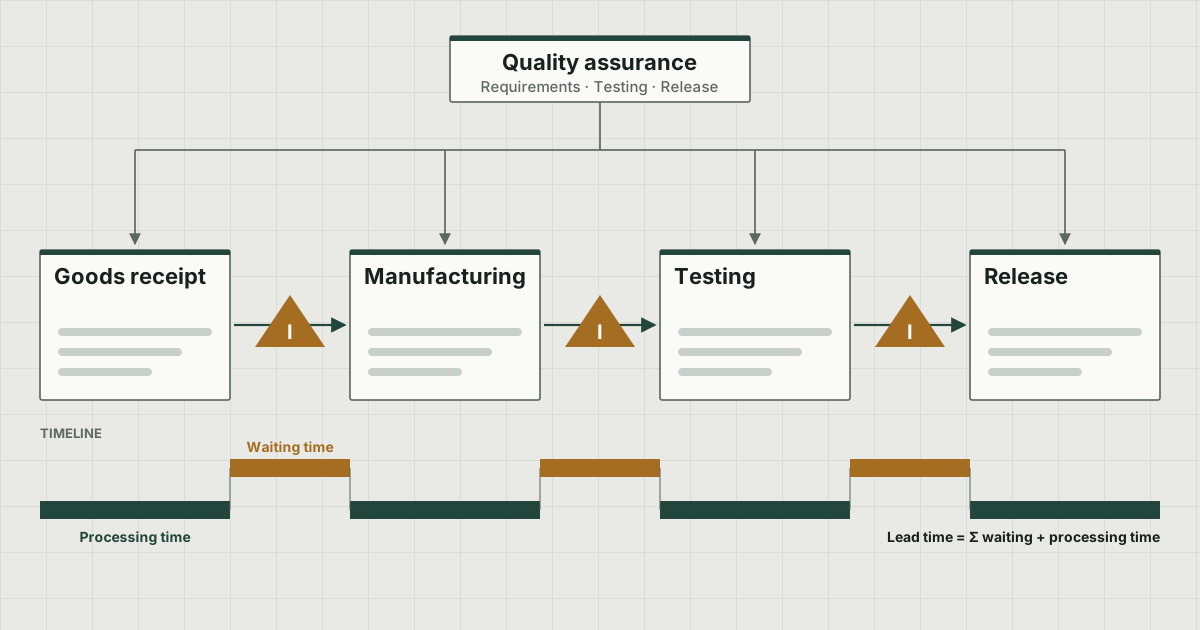
This distinction is essential in GMP-regulated operations. Quarantine, quality control, and responsible batch release are not waste. What can be improved are the handoffs and information pathways that delay those activities unnecessarily.
Value Stream Mapping Shows Material and Information Flows Together
Value stream mapping represents the steps a product or product family takes from a defined starting point to a specified outcome.
It examines two connected flows: the material flow shows where the product is and how it is processed or transported. The information flow shows which instructions, orders, inspections, feedback, and decisions direct that work.
Rother and Shook systematically described this combined view in Learning to See. [1]
A value stream map typically shows process steps, inventories or waiting states, information links, and a timeline. Small data boxes contain measures such as processing time, lead time, lot size, or other information relevant to the process.
The processing time is the time spent actively working on a defined step. The lead time covers the full period from the defined start to the end of the value stream, including idle, waiting, and handoff time.
These measures answer different questions: A machine may complete its work quickly while the batch then waits for a test result to be reviewed.
The usual value stream mapping symbols—process boxes, inventory triangles, information arrows, and timelines—are aids. What matters is that the states they represent are unambiguous in substance. Material held in quarantine is not the same as documentation left unreviewed.
Value Stream Mapping Is Performed in Five Steps
1. Define the product family and scope. A product family includes operations with sufficiently similar steps. For a GMP batch, specify whether the map starts at receipt and ends after manufacturing, after QC, or at batch release.
2. Capture the current state. The people involved trace the actual sequence, including handoffs, inventories, documents, and decisions. They map the material and information flows together.
3. Add measures to the data boxes. Record each step's start, finish, processing time, and waiting time. Distinguish observed, estimated, and recorded timestamps.
4. Investigate delays and their causes. Look for duplicate entries, missing information, unnecessary handoffs, repeated requests for documents, and unclear ownership.
5. Design the future state. Future-state value stream design describes how to organize the work more effectively while meeting the substantive requirements. Every change needs a defensible rationale.
For example, completed sections of batch documentation could be reviewed during manufacturing rather than assembled for the first time days afterward. The review requirement remains; its preparation and placement in the workflow change.
Value Stream Mapping Example: The Batch Waits for Review
The following values are entirely fictitious example data. They do not come from a GMP site and are not industry benchmarks.
The example follows fictitious batch CH-963 from receipt of the starting material through final batch release. The simplified sequence has no overlapping steps.
Waiting time is split into two categories: time required by testing or procedures and time assumed avoidable because of its underlying cause.
| Stage | Processing | Testing-/procedure-related waiting | Avoidable waiting | Illustrative cause |
|---|---|---|---|---|
| Receipt and recording | 1 h | 5 h | 0 h | Waiting for sampling (quarantine) |
| Sampling and QC testing of starting material | 4 h | 19 h | 1 h | Test cycle; delayed handoff |
| Material staging and manufacturing | 8 h | 0 h | 4 h | Material staging |
| QC testing of manufactured batch | 5 h | 19 h | 4 h | Test cycle; delayed results handoff |
| Batch record review | 3 h | 0 h | 29 h | Documents assembled late |
| Investigation of a documented deviation | 2 h | 4 h | 6 h | QA assessment; unassigned follow-up question |
| Final batch assessment and release | 2 h | 2 h | 2 h | Required review; handoff |
| Total | 25 h | 49 h | 46 h | 120 h total |
The five hours at receipt represent waiting until sampling, not the end of quarantine. The starting material remains on hold until testing and release.
The deviation investigation is also necessary: Four waiting hours are attributed to a justified QA assessment; six arise from a delayed follow-up question.
Calculating Lead Time: Worked Example
Lead time is the sum of all processing and waiting periods:
Lead time = 25 h + 49 h + 46 h = 120 hours
With uninterrupted calendar time, this is five days.
The processing-time share is:
25 ÷ 120 × 100 = 20.8%
Of total lead time, 40.8% is testing- or procedure-related waiting and 38.3% is avoidable waiting, rounded.
Of the 95 waiting hours, 49 hours are testing- or procedure-related. The other 46 result from delayed information, material handoffs, and unresolved questions.
That is the key finding: Comparing processing and waiting times alone does not show which phase to improve. Only assigning causes reveals where changes are possible without shortening required testing and review.
The difference is most apparent in the batch record review. Three hours of active work compare with 29 hours of avoidable waiting. The first improvement is not to shorten the review but to make the documents available on time.
An Electronic Batch Record can provide a useful information base because it brings together the steps actually performed and documented for a batch.
Required GMP Testing and Review Are Not Waste
Conventional value stream mapping also examines activities that add no immediate value from the product's perspective. This cannot be applied to regulated manufacturing without considering its specific requirements.
Starting material in quarantine may be used only after it has been tested and released. EU GMP Part I, Chapter 5, section 5.34 states that only starting materials released by Quality Control within their retest period may be used. Section 5.32 addresses the identification of their status, including quarantine, testing, and release. [2] An approved SOP defines how sampling and testing are to be carried out in detail.
US CGMP rules also address component testing and approval before use in 21 CFR 211.84. [3]
Similarly, QC testing, batch record review, and responsible batch assessment are not dispensable activities. Under 21 CFR 211.192, production and control records must be reviewed before release or distribution. Under EU GMP, Annex 16 describes the Qualified Person's duties in certification and batch release. [4][5]
Quarantine itself is not waste; avoidable delays in providing the information needed to end it are.
The same distinction applies to record review. When Quality Assurance returns an incomplete record, that is a justified response. The delay may result from a missing result that could have been identified and resolved during execution.
For CH-963, the aim is not less quality assurance, but complete and timely access to the evidence it needs.
Digital Value Stream Mapping Uses Execution Data Instead of Retrospective Estimates
Traditional value stream mapping involves observing workstations, asking about timing, and drawing the sequence on a shared map. It remains useful where activities or information paths are not fully visible digitally.
Digital value stream mapping, often discussed as value stream mapping 4.0, supplements observations with recorded execution data.
When task starts and finishes, and their associated process objects, are recorded with suitable timestamps, lead times can be calculated using defined rules. This supports comparing several batches rather than just one observation day.
Meudt, Metternich, and Abele describe in Value stream mapping 4.0 an extension of conventional value stream mapping that jointly considers the value stream and digital information logistics. [6]
The connection to Process Mining is close, but the methods are not identical.
Value stream mapping organizes material and information flows, processing, inventories, and waiting states around a specific improvement question. Process mining examines recorded process paths, variants, and temporal relationships using suitable event data.
For CH-963, recorded events could show how much time passed between completion of one test and the start of the next step.
Timestamps alone are not enough. For a meaningful calculation, process events must be clearly associated with a batch and work step.
An audit trail can additionally reconstruct the sequence of changes to electronic records; its entries do not necessarily mark the start and end of a work step.
Event data alone do not produce a completed value stream map. The scope of the value stream and the interpretation of time intervals must first be defined.
The Future-State Map Shortens Handoffs, Not Quality Requirements
The CH-963 analysis might show that batch record review only begins after all documents have been manually assembled following completion of manufacturing.
A better future state would examine whether completed portions of the records can be made available earlier while outstanding information remains clearly identified.
Another measure could link the trigger for a deviation investigation directly to the affected measurement and applicable work instruction. The responsible role would receive the context without searching several separate documents.
Material staging also deserves examination. If previously released starting material is assigned to its production task only after a delay, an information mismatch between the MES system and material staging may be a cause to investigate.
Future-state design must identify which handoff changes, which records remain available, and how the effect will be measured.
ICH Q10 calls for monitoring process performance and product quality and implementing improvements under control. [7]
A shorter lead time is therefore an improvement only if all required testing, records, and decisions remain complete and effective.
Advantages and Disadvantages: A Value Stream Map Shows Only the Selected Scope
The main advantage of value stream mapping is clarity. It makes material movements, information pathways, and waiting periods visible together. A bounded process can initially be examined without extensive technical infrastructure.
A conventional value stream map is, however, a snapshot of one product family. Rare exceptions or unusual paths may be missing.
When process variants are numerous, one map is often insufficient. Additional analyses can show how often different paths occur and how their lead times differ.
Examining process variants shows that the same underlying process may follow several paths in practice.
Value stream mapping is not one universal map for an entire site. It provides a bounded but verifiable view of a particular production and information flow.
Primary Sources and Further Reading
- [1] · Book Learning to See: Value Stream Mapping to Add Value and Eliminate MUDA Relevance: Origins of the method; material and information flows. Introduction from the Lean Enterprise Institute (PDF) ↑ Back to text
- [2] · Guideline EudraLex Volume 4, EU GMP Guide, Part I, Chapter 5 – Production Relevance: Status and release of starting materials (sections 5.32 and 5.34). EU Commission guidance (PDF) ↑ Back to text
- [3] · Regulation 21 CFR § 211.84 – Testing and approval or rejection of components, drug product containers, and closures Relevance: Testing and approval of components. Current version in eCFR ↑ Back to text
- [4] · Regulation 21 CFR § 211.192 – Production record review Relevance: Production record review. Current version in eCFR ↑ Back to text
- [5] · Guideline EudraLex Volume 4, Annex 16 – Certification by a Qualified Person and Batch Release Relevance: Qualified Person certification and batch release. EudraLex Volume 4 at the European Commission ↑ Back to text
- [6] · Research article Value stream mapping 4.0: Holistic examination of value stream and information logistics in production Relevance: Digital value stream mapping and information logistics. Publisher version / DOI ↑ Back to text
- [7] · Guideline Q10 Pharmaceutical Quality System Relevance: Monitoring and improving process performance. ICH guideline (PDF) ↑ Back to text
Research and sources last checked: October 28, 2026.